
Electronics
NUTY T58C vs DT830B vs ANENG AN8008
Compare listed features for low-voltage electronics, learning and bench work. Research only; no ITHutir hands-on test.
Poland / Western English · Price and availability may change. Check the retailer's website for current details.
Paid affiliate link: ITHutir may earn a commission if you buy through this external merchant. Affiliate disclosure.
Published specifications · Not hands-on tested
Jump to comparison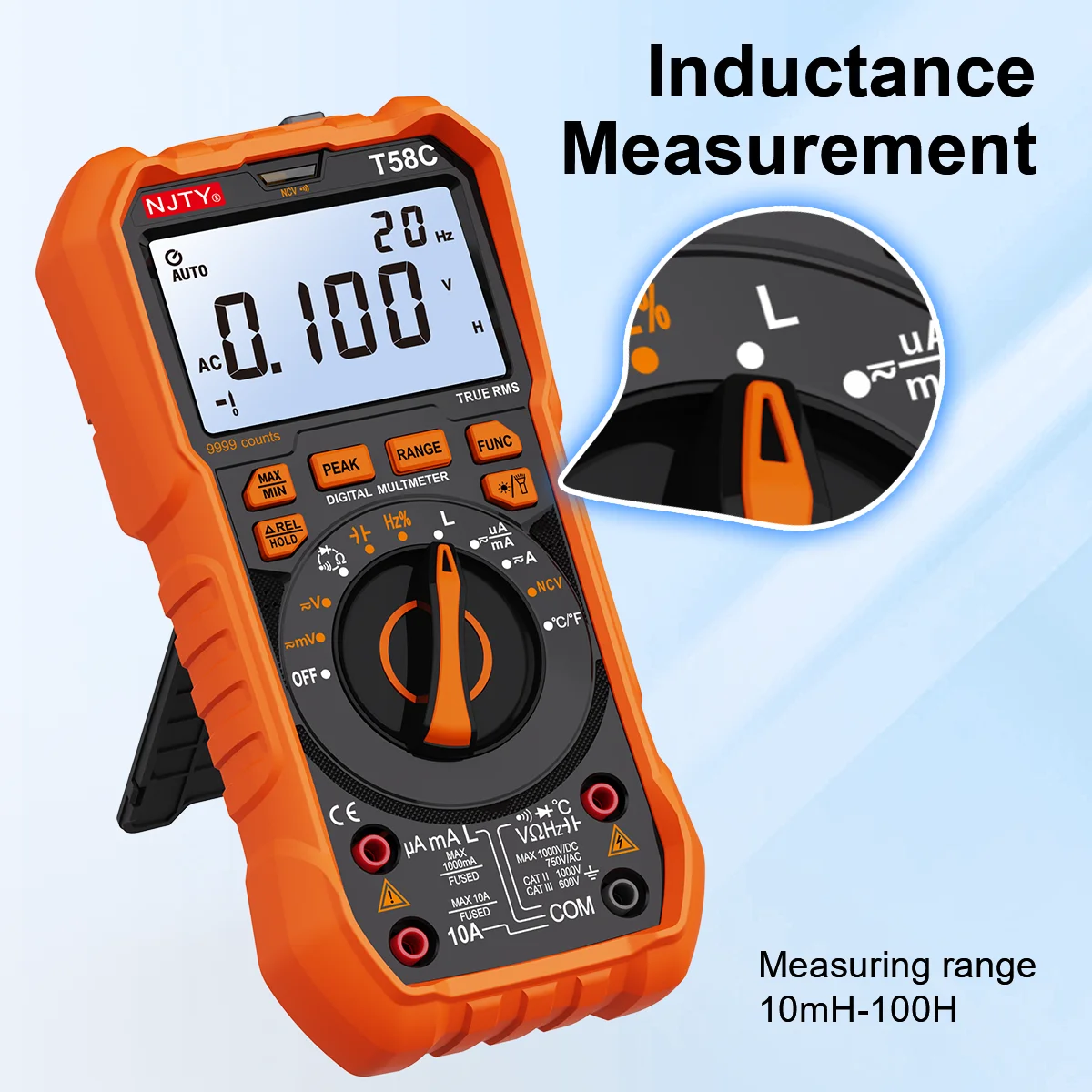

Quick verdict
Best for
Low-voltage electronics learning and hobby bench work.
Not ideal for
Choosing a meter for hazardous circuits from its feature list alone.
Price tier
Not verified — check the exact variant and current merchant price.
Why consider it
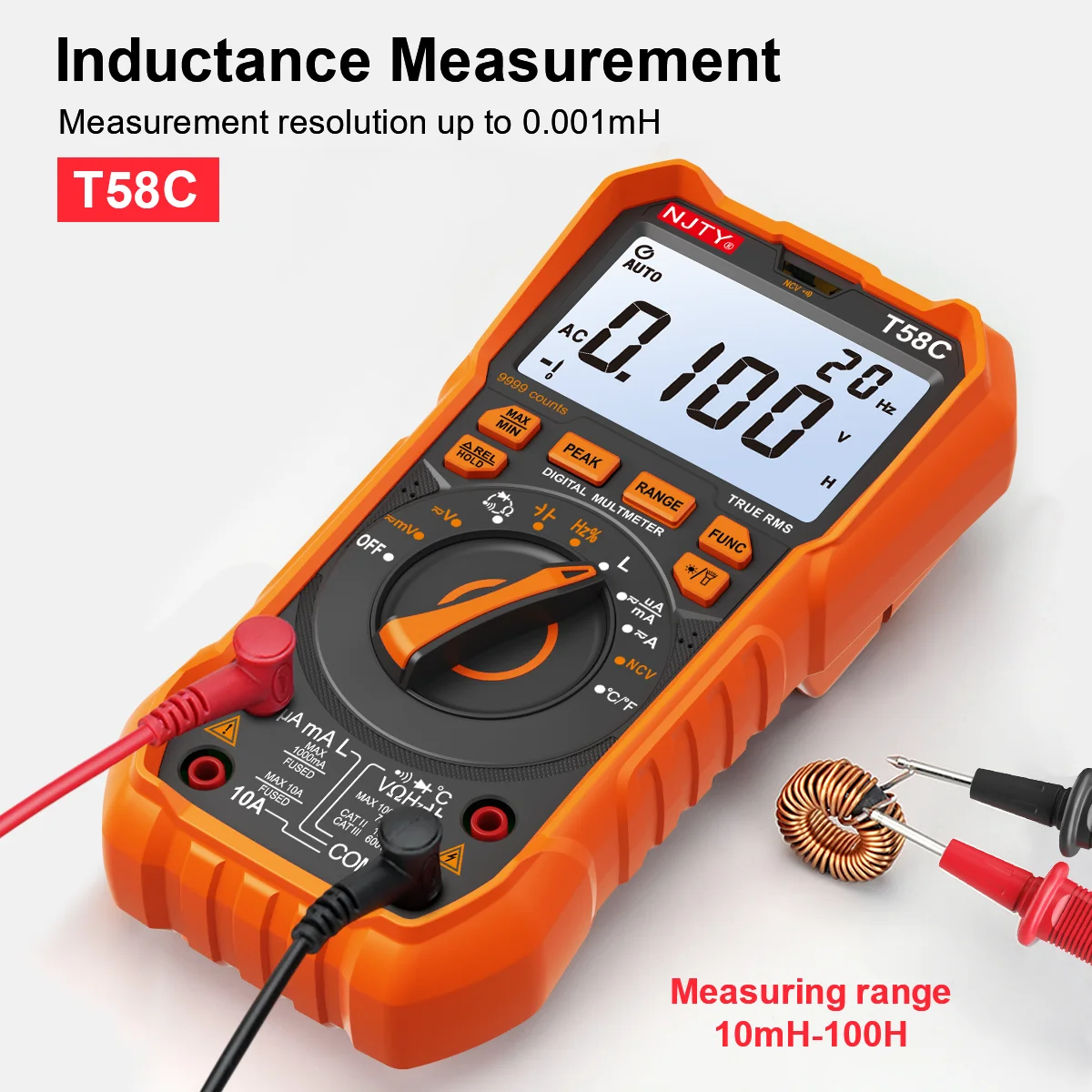
The listed inductance mode adds a reason to consider T58C for component work. These are published claims, not ITHutir test results.
Product details from the seller
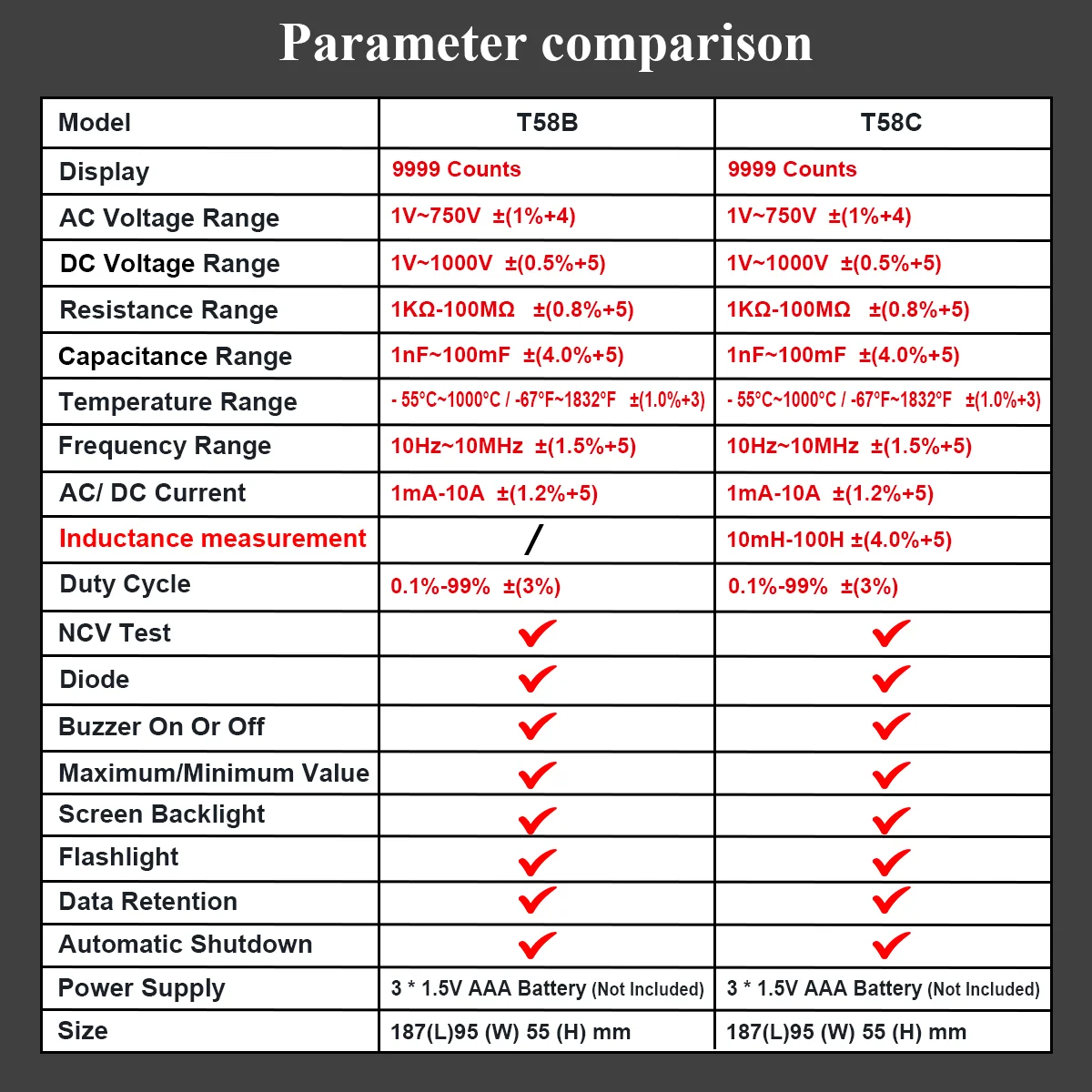
Open any image at full size to read seller feature cards.


Advantages and limitations
Pros
- Auto ranging can reduce manual range changes.
- Inductance and capacitance modes broaden component checks.
- Large backlit display is listed; real-world readability remains untested.
Cons / unknowns
- No formal ITHutir hands-on testing has been completed.
- Input protection, fuse arrangement and CAT rating require exact-unit verification.
- Price, included accessories and T58B variant differences are not verified.
Who it's for
Beginners
Start with low-voltage circuits and learn function, range and probe selection.
DIY electronics hobbyists
Consider the listed capacitance and inductance modes for component exploration.
Home troubleshooting
Limit initial learning to low-voltage devices; this is not a mains-safety recommendation.
Learning / bench use
Compare the listed display and range modes against the measurements you actually need.
Compare the measurement workflow
Published claims from the existing research record; not independently measured. Suitability is editorial interpretation. Unknown fields remain unverified.
| Criterion | NUTY / NJTY T58C listing | DT830B | ANENG AN8008 |
|---|---|---|---|
| User level | Beginner / hobby bench (editorial) | Learning manual ranges (editorial) | General electronics hobbyist (editorial) |
| Range mode | Auto ranging | Manual | Auto / manual |
| Display | 9999 counts; large backlit display | 1999 counts | 9999 counts |
| Inductance | Listed | Not verified | Not verified |
| Portability | Dimensions / weight not verified | Dimensions / weight not verified | Compact class; dimensions not verified |
| Feature depth | Voltage, current, capacitance, inductance | Core measurement functions | True RMS, capacitance, frequency, duty cycle |
| Price tier | Current relative pricing not verified | Current relative pricing not verified | Current relative pricing not verified |
| Best use case | Low-voltage component bench work (editorial) | Manual-range learning (editorial) | Compact general electronics kit (editorial) |
Poland / Western English · Price and availability may change. Check the retailer's website for current details.
Paid affiliate link: ITHutir may earn a commission if you buy through this external merchant. Affiliate disclosure.
Quick answer
The DT830B represents the old-school ultra-budget approach: manual ranging, a 1999-count display and the core voltage, current, resistance and diode functions. It can still teach the fundamentals, but the user has to choose ranges manually and the feature set is narrow.
The ANENG AN8008 moves into a newer compact class with a 9999-count display, auto/manual ranging, True RMS, capacitance, frequency and duty-cycle measurement. The NUTY T58C listing we checked is aimed at a broader bench-work role: 9999 counts, auto ranging, voltage/current, capacitance, inductance and a large backlit display.
Why the old DT830B is still useful — and where it feels old
A DT830B-style meter is useful for learning the basic relationship between function, range and expected value. Its manual range selector forces the user to think about whether a circuit is in millivolts, volts, ohms or kilo-ohms.
The trade-off is convenience and headroom. Published DT830B documentation describes a 1999-count display, manual ranging, DC and AC voltage, DC current, resistance, diode test and transistor hFE test. For regular electronics work, that means more dial changes and fewer secondary measurement functions than newer meters.
- Best when the purchase price must be minimal
- Good for basic low-voltage learning and simple continuity-style troubleshooting
- Less convenient when moving repeatedly between ranges and measurement types
ANENG AN8008: the compact modern budget alternative
The ANENG AN8008 is a stronger reference point for the T58C because it already offers many modern conveniences. Published manuals list a 9999-count display, auto/manual ranging, True RMS, capacitance, frequency, duty cycle, diode and continuity functions.
Its strength is compactness and breadth for general electronics. Its limitation in this comparison is that the T58C listing explicitly adds inductance measurement and a larger, more bench-oriented display layout, which can matter to users working with coils, filters, power electronics or component identification.
Where the NUTY T58C makes more sense
Auto ranging can reduce manual range selection. Display counts describe resolution, not verified accuracy or safety; choose functions for the measurements you actually need.
The T58C is also more interesting for makers who may move from Arduino or ESP32 projects into power supplies, sensors, motors, coils and general component troubleshooting. Inductance measurement is not essential for a first multimeter, but it expands what the same tool can do later.
- Consider T58C for its listed inductance function.
- Compare AN8008 if compactness matters; check the exact manual.
- Compare DT830B if learning manual ranging is a priority; verify the exact unit.
Important safety distinction
More functions do not automatically mean a safer meter. Before using any budget multimeter on mains wiring, high-energy power supplies or other hazardous circuits, verify the exact model manual, CAT rating, input protection and fuse arrangement for the specific unit you receive.
For beginners, low-voltage electronics is the right place to learn measurement technique before moving to hazardous circuits.
ITHutir position today
This comparison is based on published specifications and the current AliExpress T58C listing, not yet on a formal ITHutir hands-on test protocol. We plan a separate real-world T58C review later, including usability, beginner workflow and practical electronics measurements.
The T58C is worth comparing for its listed inductance function. No winner on accuracy, protection or value is established by this specification-only comparison. The existing mapping identifies NUTY T58C; NJTY/T58B seller naming and variant equivalence must be checked on the exact listing.
Recommended components
NUTY T58C Digital Multimeter
Check Price at AliExpress
Poland / Western English · Price and availability may change. Check the retailer's website for current details.
Paid affiliate link: ITHutir may earn a commission if you buy through this external merchant. Affiliate disclosure.
Before you choose
Check the exact model, functions, protection and included contents on the listing and manual. Match the tool to your measurement task.
Poland / Western English · Price and availability may change. Check the retailer's website for current details.
Paid affiliate link: ITHutir may earn a commission if you buy through this external merchant. Affiliate disclosure.